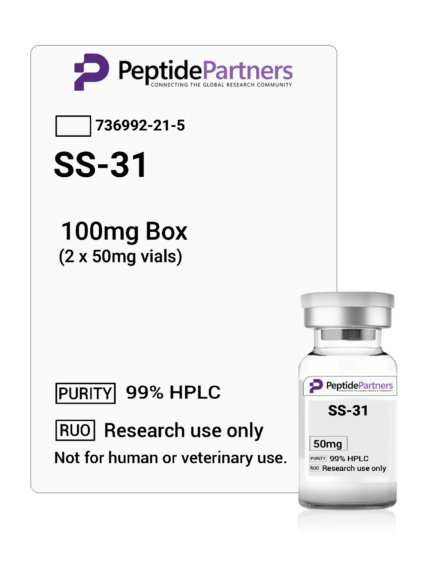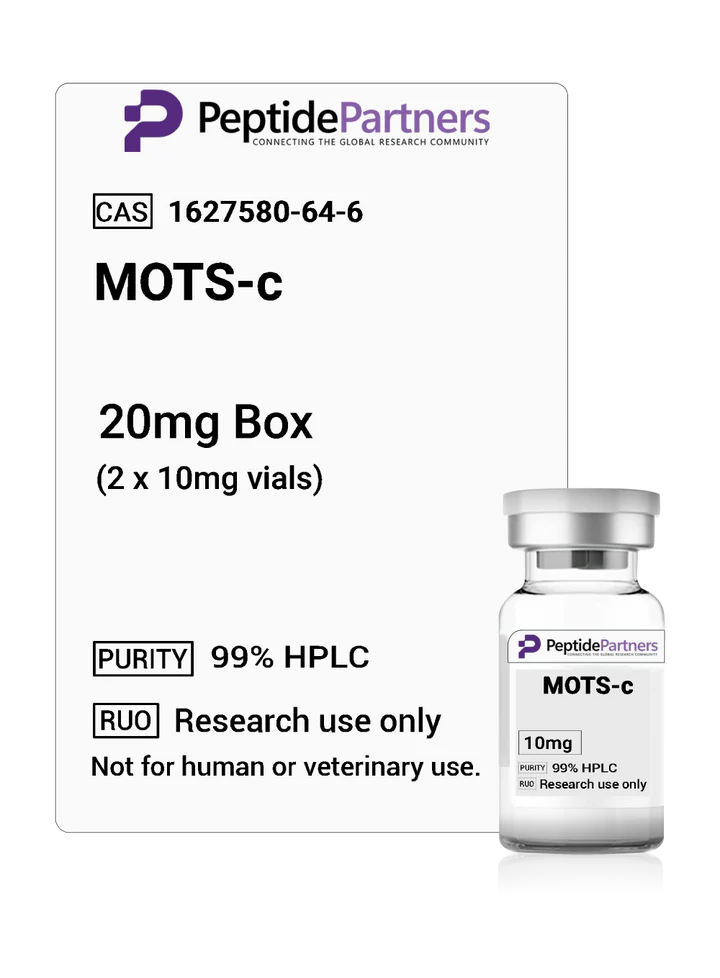


MOTS-c (10mg vials)
Price range: $79.00 through $338.00
• Purity: 99.98% (multi-vial, independently tested)
• Format: 10mg vials (3 mL capacity)
• Box Options: 20mg, 50mg, 100mg combinations
• Testing Status: Heavy metals & purity screening PASSED
• Cost Efficiency: $3.38 – $3.95 per milligram
MOTS-c is a mitochondrial genome-encoded peptide investigated for its role in metabolic regulation, muscle differentiation, and mitochondrial-nuclear crosstalk. This research-grade material supports in-vitro experimentation focused on myogenesis, Bcl-2 interactions, CK2 kinase activation, STAT3 signaling modulation, and mitochondrial stress response pathways.
- Independent certificate details, manufacturer IDs, and batch IDs should be reviewed before purchase when available.
- Order cancellations for full refunds are available before shipment; shipped orders cannot be cancelled or refunded.
- For damaged or incorrect goods, photograph the outer packaging, inner packaging, and product labels, then email support within 48 hours of carrier delivery.
Buy MOTS-c – Peptide Partners
Product Overview & Specifications
MOTS-c (mitochondrial open reading frame of the 12S rRNA-c) is a mitochondrial genome-encoded peptide investigated for its role in metabolic regulation, muscle differentiation, and mitochondrial-nuclear crosstalk. Peptide Partners supplies this research-grade material for in-vitro testing, laboratory experimentation, receptor pharmacology, structural biology, and preclinical metabolic research.
Published studies have examined MOTS-c using myoblast cell lines (LHCN-M2, C2C12), hepatocyte models, protein-protein interaction assays, metabolomic profiling, kinase activation studies, and transcription factor binding analyses. Research areas include myotube formation, STAT3 signaling modulation, Bcl-2 interactions, CK2 kinase activation, mitochondrial metabolic reprogramming, and inflammatory pathway regulation.
The product name supplied for this listing is “MOTS-c.” Researchers should verify the exact identity, sequence, formulation, and batch-specific certificate of analysis before beginning any experiment. Findings from published MOTS-c studies should not be assumed to apply to every commercial batch or formulation.
Product Specifications
| Specification | Details |
|---|---|
| Product name | MOTS-c |
| Compound type | Mitochondrial genome-encoded peptide (16 amino acids) |
| Primary molecular targets | STAT3 transcription factor, Bcl-2 protein, protein kinase CK2 |
| Primary research areas | Metabolic regulation, muscle differentiation, mitochondrial-nuclear crosstalk, Bcl-2 interactions, CK2 kinase activation, and inflammatory signaling |
| Product format | 10 mg vials |
| Vial size | 10 mg |
| Vial capacity | 3 mL |
| Available box combinations | 20 mg, 50 mg, and 100 mg |
| Multi-vial purity | 99.98% |
| Independent testing | Yes |
| Heavy-metals screening | Passed |
| Purity screening | Passed |
| Manufacturer ID | WF03 |
| Batch ID | MC202605 |
| Cost per milligram | $3.38–$3.95 |
The stated 99.98% purity is based on multi-vial testing. Researchers should review the batch-specific certificate of analysis before beginning any experiment.
Primary Research Studies & Findings
MOTS-c Promotes Muscle Differentiation In Vitro
Authors: Sandra García-Benlloch, Francisco Revert-Ros, Jose Rafael Blesa, and Rafael Alis
Publication: Peptides (ScienceDirect), 2022
DOI: 10.1016/j.peptides.2022.170891
Reference: View publication
This study investigated the effect of MOTS-c on myogenesis in human (LHCN-M2) and murine (C2C12) myoblasts. The findings indicate that wild-type MOTS-c peptide enhances myotube formation, whereas a variant with a substitution at tyrosine 8 (Y8F) does not. Furthermore, wild-type MOTS-c, but not the Y8F peptide, was shown to counteract the interleukin-6 (IL-6)-induced reduction of nuclear myogenin.
The proposed mechanism is that MOTS-c interacts with the STAT3 transcription factor via its putative SH2 binding motif (YIFY region), thereby reducing STAT3’s transcriptional activity and promoting myotube formation. The researchers demonstrated that the YIFY motif is critical for MOTS-c’s biological activity in muscle cell differentiation models.
The study provides mechanistic insights into how mitochondrial-derived peptides can influence nuclear gene expression and cellular differentiation programs. The findings suggest MOTS-c as a valuable research tool for studying mitochondrial-nuclear crosstalk and muscle development pathways.
Plain-English Research Summary
This research explored how a naturally occurring peptide called MOTS-c affects muscle cell development. Using muscle cells from both humans and mice, the scientists found that MOTS-c helps these cells to mature and form muscle fibers. They also discovered that a specific part of the MOTS-c molecule is crucial for this process. When this part was altered, the beneficial effect was lost. The study suggests that MOTS-c works by influencing a key protein (STAT3) involved in cell growth, which in turn enhances the formation of new muscle tissue.
The Mitochondrial Genome-Encoded Peptide MOTS-c Interacts with Bcl-2 to Alleviate Nonalcoholic Steatohepatitis Progression
Authors: Huanyu Lu, Linni Fan, Wenli Zhang, Guo Chen, An Xiang, Li Wang, Zifan Lu, and Yue Zhai
Publication: Cell Reports (ScienceDirect), 2023
DOI: 10.1016/j.celrep.2023.113599
Reference: View publication
This study elucidates the molecular mechanism by which MOTS-c ameliorates nonalcoholic steatohepatitis (NASH). The research demonstrates that MOTS-c directly interacts with the BH3 domain of the antiapoptotic protein B-cell lymphoma-2 (Bcl-2). This interaction enhances Bcl-2 protein stability by suppressing its ubiquitination.
In vitro experiments using a Bcl-2 inhibitor and adeno-associated virus (AAV)-mediated Bcl-2 knockdown confirmed that the protective effects of MOTS-c against NASH-induced mitochondrial dysfunction, inflammation, and fibrosis are dependent on Bcl-2 function. Metabolomic analysis further revealed that MOTS-c reverses NASH-induced mitochondrial metabolic deficiencies.
The findings establish a direct molecular interaction between MOTS-c and Bcl-2, linking mitochondrial peptide signaling to apoptotic regulation and metabolic homeostasis. The research provides a mechanistic framework for understanding how mitochondrial-derived peptides can influence liver pathology in experimental models.
Plain-English Research Summary
This research uncovers how a natural peptide called MOTS-c can help protect the liver from a serious condition called nonalcoholic steatohepatitis (NASH), which is a severe form of fatty liver disease. The scientists discovered that MOTS-c works by interacting with a protein called Bcl-2, which is known to prevent cell death. By binding to Bcl-2, MOTS-c makes it more stable and prevents it from being broken down by the cell. This action helps to restore normal function to the mitochondria, the powerhouses of the cells, and reduces the inflammation and scarring associated with NASH.
MOTS-c Modulates Skeletal Muscle Function by Directly Binding and Activating CK2
Authors: Hiroshi Kumagai, Su-Jeong Kim, Brendan Miller, et al.
Publication: iScience (Cell Press), 2024
DOI: 10.1016/j.isci.2024.111237
Reference: View publication
This study identifies protein kinase CK2 as a direct and functional target of MOTS-c. In vitro, cell-free systems demonstrated that MOTS-c directly binds to and activates CK2. This interaction is crucial for the metabolic effects of MOTS-c. The study also investigated a naturally occurring variant, K14Q MOTS-c, which showed reduced binding to CK2 and a concomitant lack of activation.
The researchers used biochemical assays, structural modeling, and functional studies to characterize the MOTS-c–CK2 interaction. The K14Q variant’s reduced binding affinity provided a molecular basis for the observed physiological effects, linking the in vitro findings to in vivo and clinical observations.
The findings establish CK2 as a direct downstream effector of MOTS-c signaling, providing mechanistic insights into how this mitochondrial peptide regulates cellular metabolism. The research demonstrates that single amino acid variations can significantly alter peptide-protein interactions and biological activity.
Plain-English Research Summary
This research discovered that a small protein called MOTS-c works by directly switching on an enzyme called CK2. Using experiments in a test tube, the scientists showed that MOTS-c binds to CK2 and activates it. This is like a key fitting into a lock to turn on a machine. They also found that a common variation of the MOTS-c ‘key’ doesn’t fit the CK2 ‘lock’ as well, and so it can’t turn on the machine. This discovery helps to explain how MOTS-c affects our bodies at a molecular level, and why some people might be more prone to certain health issues.
Standard Research Disclaimer
Research Use Only. Not for use in diagnostic tests.
This product is solely intended for research purposes as a chemical compound. It is designated exclusively for in-vitro testing and laboratory experimentation. All information provided about this product is educational and should be evaluated by appropriately qualified research personnel.
By law, bodily introduction of this product into humans or animals is strictly prohibited. This compound must not be used, administered, or represented as a drug, food, dietary supplement, metabolic treatment, muscle-building compound, liver treatment, diagnostic material, or medical treatment. It is not intended to diagnose, treat, cure, or prevent any disease. It should be handled only by licensed and qualified professionals in an appropriately equipped laboratory and in accordance with applicable laws, institutional procedures, and relevant safety requirements.
| Choose pack |
2 vials × 10mg (20mg total) ,5 vials × 10mg (50mg total) ,10 vials × 10mg (100mg total) |
|---|
- All of our manufacturing partners produce peptides using the Lyophilization (Freeze Drying) process, ensuring products maintain stability for shipping and storage for 12+ months.
- In lyophilized form, they are shelf-stable for many weeks. However, for long-term storage, it is recommended to store them in the freezer.
- We often hear concerns about the standard "discard after 28 days of first use" disclaimer. Don't worry, this has nothing to do with studies regarding the efficacy of specific peptides. 28 days is the FDA requirement for producers of multi-use vials to prove their bacteriostatic maintains efficacy. This minimum requirement becomes the de facto standard.
- In our experience, if you use proper sterile procedures and refrigerated storage, you can continue sampling from the same reconstituted vial for 3+ months.
Certificate records
No published certificate records are available for this product.
Search Certificate LedgerRelated products
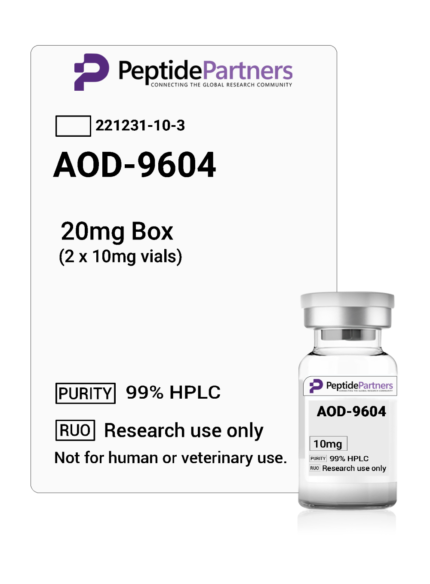
AOD-9604 (10mg vials)
Price range: $134.00 through $520.00
Epithalon (40mg vials)
Price range: $216.00 through $792.00
MOTS-c (40mg vials)
Price range: $252.00 through $800.00
NAD+ Buffered (900mg vials)
Price range: $198.00 through $738.00
Pinealon (20mg vials)
Price range: $100.00 through $340.00
SS-31 (10mg vials)
Price range: $110.00 through $450.00